Docker Swarm and Kubernetes are two of the most prevalent container orchestration solutions when teams begin considering one. While these two tools address the same fundamental issue, they do so in quite different ways.
In 2026, choosing between these two tools may affect your infrastructure, your team’s workflow, and your future expenses.
Docker Swarm is simpler to set up and best for small to medium teams with predictable workloads. Kubernetes is more complex but handles large-scale, auto-scaling, multi-cloud deployments. For most production environments in 2026, Kubernetes is the industry standard.
In this guide, we have outlined Docker Swarm vs Kubernetes in the most important areas that are important to help you make the right decision.
What is Docker Swarm
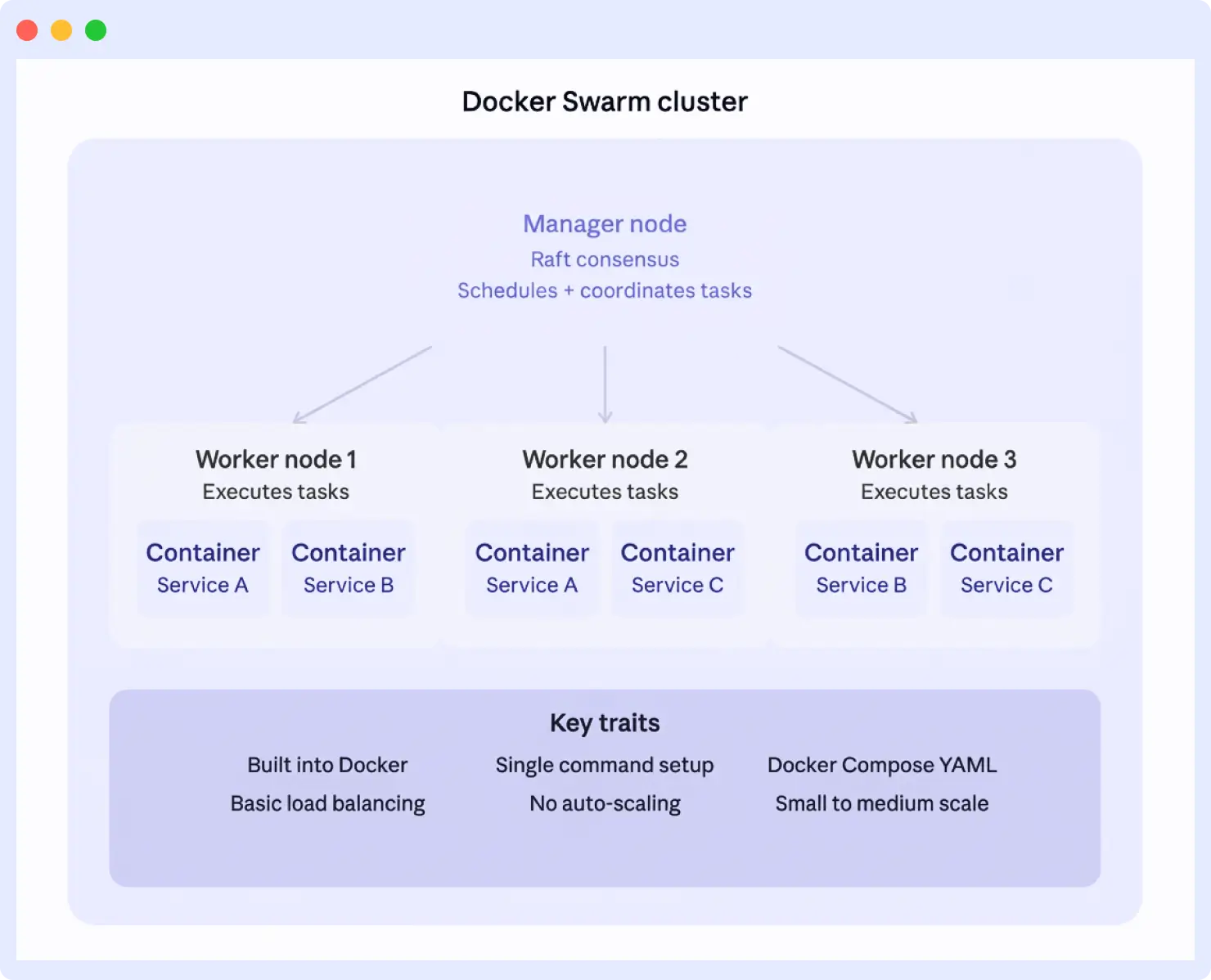
Docker Swarm is Docker’s built-in application for managing containers across multiple machines. Rather than managing each host individually, it allows you to group them into a single cluster and manage them as a system. Swarm distributes, schedules, and maintains containers. Once configured, you do not need to handle each container separately.
A swarm cluster has two types of nodes. Manager nodes coordinate the cluster and make decisions, while worker nodes do the actual work by running containers. Defining an application as a service and ensuring it runs on the cluster based on the settings you provide is known as deploying an application, and Swarm does this.
Pros of Docker Swarm
- Easy to set up using the Docker CLI
- Works well with existing Docker tools and workflows
- Lower learning curve compared to Kubernetes
- Lightweight with minimal resource overhead
- Built-in load balancing, scaling, and self-healing
- Automatically restarts failed containers and redistributes workloads when nodes go down
Cons of Docker Swarm
- Limited customization compared to Kubernetes
- No built-in auto-scaling
- A less robust ecosystem and reduced third-party integrations.
- Not so suitable in complex or large-scale applications.
What is Kubernetes
Kubernetes is an open-source container orchestration system, initially created by Google and currently maintained by the Cloud Native Computing Foundation (CNCF). It is an automated deployment, scaling, and management of containerized applications across clusters of machines.
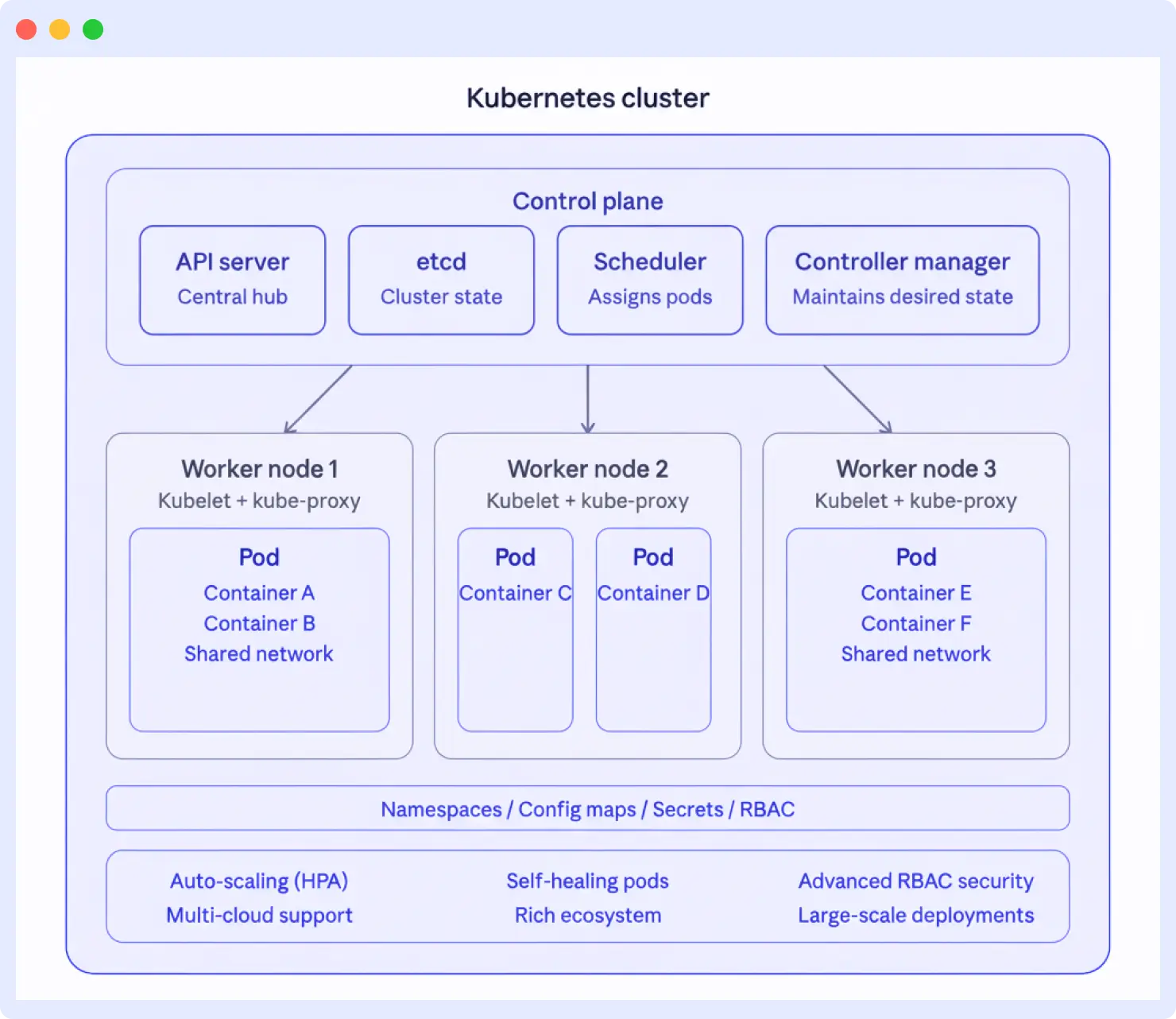
A Kubernetes cluster consists of a control plane that coordinates the system’s overall state and worker nodes that execute application workloads. Applications in Kubernetes are deployed inside pods, the smallest unit, found inside these nodes.
It has been developed to manage complex, distributed systems with high control over deployment, scaling, and availability.
Pros of Kubernetes
- Highly scalable, capable of managing thousands of nodes
- Self-healing automatically restarts and replaces failed containers
- Built-in support for auto-scaling
- Advanced scheduling and workload management
- Large, active open-source community
- Supported by all major cloud providers, including AWS, Google Cloud, and Azure
- An extensive ecosystem of third-party tools and integrations
Cons of Kubernetes
- Complex setup and steep learning curve
- Requires significant time and expertise to manage effectively from pod failures like CrashLoopBackOff to resource limit errors. Kubernetes workload troubleshooting is a discipline on its own
- Higher resource overhead compared to Docker Swarm
- Can be overkill for small or simple applications
- Often requires additional tools for monitoring, K8 logging, and full operational setup
Docker Swarm vs Kubernetes: complete comparison (2026)
Below is a side-by-side comparison of widely used real user monitoring tools based on core capabilities.
| Features | Docker Swarm | Kubernetes |
| Installation & Setup | Simple, quick setup | Complex setup |
| Architecture | Manager and worker nodes | Control plane, worker nodes, and pods |
| Learning Curve | Easy | Steep |
| Scalability | Small to medium | Large scale |
| Security | Basic TLS encryption | Advanced security (RBAC, policies) |
| Auto-scaling | Not supported | Supported |
| Load balancing | Built-in, basic | Advanced, highly configurable |
| Monitoring | External tools | Built-in dashboards and external tools |
| Ecosystem & Community | Small | Large and active |
| Cloud Integrations | Limited | All major cloud providers |
Key differences: Docker Swarm vs Kubernetes
Docker Swarm vs Kubernetes: architecture
Docker Swarm has a very simple architecture of manager and worker nodes, where the manager node coordinates and makes decisions for the cluster, and the worker node executes the containers. A consensus algorithm known as Raft is used by the manager nodes to ensure the cluster’s state, and, in the event of a manager node failure, the remaining manager node takes over without interrupting running services.
Kubernetes is a more layered approach. It isolates the control plane and the worker nodes, and in the latter, applications are executed in pods. The smallest deployable unit in Kubernetes is a pod, which can contain one or more containers sharing a common network and storage. Kubernetes also introduced new concepts such as namespaces, config maps, and deployments, which offer greater control but introduce more components to manage.
The key architectural difference between Docker Swarm and Kubernetes is that Swarm uses a flat manager/worker model, whereas Kubernetes separates the control plane from worker nodes and introduces pods as the smallest deployable unit.
Verdict: The fundamental distinction is that Docker Swarm is built to be simple, whereas Kubernetes is built to be flexible and scalable.
Docker Swarm vs Kubernetes: installation and setup
Docker Swarm is easy to start with. There is no software to install, as it is built directly into Docker. Assuming that Docker is already up and running, the first command to initialize a cluster is: docker swarm init. Adding worker nodes and deploying services can be done almost instantly there. For a team already familiar with Docker, the installation is smooth.
To monitor your Docker environment once it’s running, see how to install the Middleware Docker agent.
The installation of a Kubernetes cluster includes several components, such as the API server, controller manager, scheduler, and etcd (the distributed key-value store that stores the Kubernetes cluster state). All of these must be set up correctly before the cluster is configured. Your environment can also be a source of variability in the installation process, contributing to the complexity.
As a result, most teams do not manually set up their teams and rely on managed services such as Amazon EKS, Google GKE, or Azure AKS. These services will handle much of the cluster’s setup and maintenance, but at a higher cost.
Verdict: Docker Swarm is faster and easier to set up. Kubernetes takes more time and technical effort, though managed cloud services help close that gap.
Docker Swarm vs Kubernetes: deployment and scalability
Docker Swarm uses the same Docker Compose YAML files that most teams are familiar with to deploy applications as services. You specify the number of copies of a service you want, and Swarm distributes them across your worker nodes. This is effective for small to medium applications with predictable scaling requirements that do not vary frequently. Scaling Docker Swarm, however, is largely manual and may be restrictive as the number of systems increases.
Applications in Kubernetes are deployed with a mix of pods, deployments and services, giving you greater control over how your application is executed.
To effectively debug and monitor application behavior during scaling events, teams typically rely on kubectl log tailing to stream live container output across pods. You can specify resource limits, update strategy, and rollback behavior.
Kubernetes also offers automatic scaling based on metrics such as CPU utilization or traffic, which is more appropriate for applications with varying demand or under heavy load.
When you need to scale fast and when your application can fluctuate in demand without having to do it manually, Kubernetes is the option of choice. When your workload is predictable and manageable in size, the simpler approach of Docker Swarm usually suffices.
Verdict: For predictable, stable workloads, Docker Swarm is usually enough. For systems that need autoscaling and handle variable demand, Kubernetes is the stronger option.
Docker Swarm vs Kubernetes: networking
Docker Swarm relies on an overlay network to manage communication among containers across multiple nodes. Incoming traffic is controlled by default ingress network, which automatically allocates requests to containers that are running. This is effective in simple applications, but it has limited control over more complex networks.
Kubernetes assigns each pod a unique IP address, enabling pods to address one another. It also has more sophisticated networking extensions, such as Calico and Flannel, that allow the definition of policies controlling service communication. Moreover, Kubernetes offers a wide range of ingress options, such as Nginx, Traefik, and cloud provider load balancers.
In practice, Docker Swarm maintains the simplicity and ease of networking, but Kubernetes provides additional control over complex routing and traffic management.
Verdict: Docker Swarm covers basic networking needs. Kubernetes provides tools for advanced traffic control, custom routing, and network-level security.
Docker Swarm vs Kubernetes: ease of use and learning curve
Docker Swarm is often considered the less challenging of the two tools to learn. The transition to orchestration is natural, as it is part of Docker and uses the same CLI and Compose files that many developers are already familiar with. The working cluster can be implemented on most teams within hours.
Kubernetes is more difficult to learn. Among pods, deployments, services, namespaces, config maps, and ingress controllers, numerous concepts to learn before you are comfortable with operating a cluster. Most teams must also master kubectl, the command-line tool for Kubernetes, along with other tools and workflows.
As soon as your team is at ease with Kubernetes, it provides you with greater control and automation. Docker Swarm is easier to get started with and suitable for small teams or those new to orchestration.
Verdict: Docker Swarm is easier to set up than Kubernetes because it requires no additional installation. It is built directly into Docker and can be initialized with a single command (docker swarm init). Kubernetes, by contrast, requires configuring multiple components, including the API server, etcd, scheduler, and controller manager.
Docker Swarm vs Kubernetes: ecosystem and community
Docker Swarm has a smaller ecosystem. It works well with Docker-native tools like Docker Compose and Docker Hub, but third-party integrations are limited. For monitoring, teams must manually configure external container monitoring tools Prometheus or Datadog, which require manual configuration, and Docker logging must also be set up separately, adding overhead.
CI/CD support through platforms like Jenkins or GitHub Actions requires additional setup. Community activity has also slowed considerably in recent years, which means fewer updates, fewer plugins, and less troubleshooting support when things go wrong.
Kubernetes sits at the center of the modern cloud-native ecosystem. It integrates natively with a wide range of tools across every layer of the stack, including CI/CD platforms like Jenkins, GitLab, and ArgoCD (a GitOps continuous delivery tool for Kubernetes), Kubernetes monitoring tools like Prometheus and Grafana, security tools like Falco and OPA, and service meshes like Istio and Linkerd.
All major cloud providers, including AWS, Google Cloud, and Azure, offer managed Kubernetes services with built-in support and tooling. The community is one of the largest in open source, meaning faster development, more resources, and stronger long-term support.
For teams making a long-term infrastructure decision, the ecosystem gap between the two tools is significant and worth considering when choosing.
Verdict: The ecosystem gap between the two tools is significant. Kubernetes has stronger long-term support, more integrations, and a much larger community behind it. As of 2026, Kubernetes powers over 70% of enterprise container workloads, while Docker Swarm is primarily used by smaller teams or legacy environments.
Docker Swarm vs Kubernetes: security
Docker Swarm has built-in security. Mutual TLS is used to encrypt communication between nodes and is automatically enabled by Swarm when you create a cluster. It is also capable of managing secrets, including sensitive information such as passwords and API keys. This makes it safe enough to perform easy and moderately difficult deployments without much configuration.
Kubernetes provides a more detailed security model. It also helps Role-Based Access Control (RBAC), which enables you to specify what each user or service is permitted to access in the cluster. In addition, Kubernetes offers network policies to manage traffic between pods, advanced secrets management, and the ability to establish security rules with fine-grained control across your entire infrastructure.
In regulated industries or for sensitive workloads, the breadth of Kubernetes security controls is a valuable advantage over Docker Swarm.
Verdict: For teams with strict security requirements, Kubernetes offers the depth and control that Docker Swarm simply does not match.
Use cases: Docker Swarm vs Kubernetes
Kubernetes use cases
- Large-scale production environments: Kubernetes is a strong fit when your application needs to reliably serve a high volume of users. It handles the complexity of managing many services, distributes traffic efficiently through tools like NGINX or cloud load balancers, and recovers automatically when something breaks.
- Applications with unpredictable traffic: If your workload spikes at certain times, such as during a product launch or seasonal demand, Kubernetes auto-scaling (via the Horizontal Pod Autoscaler) lets your infrastructure scale up and back down as needed.
- Teams that deploy frequently: Kubernetes works well for teams shipping updates often, especially those running a microservice architecture in Docker. Its rolling updates and rollback capabilities, combined with tools such as Jenkins, GitLab CI, or Argo CD, enable releases without downtime.
- Multi-cloud infrastructure: Organizations running workloads across multiple cloud providers benefit from Kubernetes’ ability to run consistently across environments, using managed services such as Amazon EKS, Google GKE, or Azure AKS.
Docker Swarm use cases
- Internal tools and low-traffic applications: Not every application needs advanced orchestration. For internal dashboards, admin panels, or services with steady traffic, Swarm is often sufficient.
- Fast environment setup: When a team needs a working multi-container environment quickly, such as for demos, staging, or short-term projects, Swarm is faster to set up.
- Small teams with limited DevOps resources: Swarm is easier to manage and maintain, though teams should still follow Docker best practices, such as routine image and container cleanup, to avoid disk bloat over time, making it a good fit for teams without dedicated infrastructure engineers.
- Simple production deployments: For applications with predictable workloads and minimal scaling needs, Swarm provides a straightforward way to run containers in production without added complexity.
How to choose the right tool: Docker Swarm vs Kubernetes
While Docker Swarm and Kubernetes can both run your applications, choosing between them depends on several factors, especially your organization’s needs and the level of complexity you expect to handle.
Choose Docker Swarm if:
- Your team is small and already familiar with Docker
- You need a simple setup with a low learning curve
- Your application is small to medium scale with predictable traffic
- You have limited DevOps resources or experience
- Speed of deployment matters more than advanced features
Choose Kubernetes if:
- You are building for large-scale or expect significant growth
- Auto-scaling and self-healing are needed in your application.
- You require enhanced security, network, or storage facilities.
- Your team is ready to spend time learning the platform, including understanding and resolving Kubernetes errors that arise during deployment and scaling.
- You need deep integrations with cloud providers and third-party tools
Another option to consider is longevity. Kubernetes is now the industry standard for orchestrating containers, with broad adoption and a significant community. Docker Swarm, however, remains a viable and stable choice for simpler use cases, despite its smaller ecosystem. When making long-term infrastructure decisions, it is a good idea to consider both your current needs and the size of your system.
- Choose Docker Swarm if you have a small team, a simple app
and need to get running fast with minimal DevOps overhead. - Choose Kubernetes if you need auto-scaling, multi-cloud support,
advanced security (RBAC), and have a team ready to invest in the platform.
In 2026, Kubernetes is the industry default for production workloads.
Docker Swarm remains a valid choice for simpler, stable environments.
Container Observability with Middleware
Middleware provides real-time observability across containers, clusters, and applications by bringing metrics, logs, and traces into one unified view. Instead of switching between tools, you can trace a failing request directly to the exact container, pod, and underlying resource responsible for the issue.
Everything you need to monitor your containers
- Real-time visibility into container performance, including CPU, memory, disk, and network usage
- Automatic mapping of services across Kubernetes and container environments
- Centralized log aggregation linked with metrics and traces for context
- End-to-end distributed tracing across microservices in containers
- Full Kubernetes insight across pods, nodes, namespaces, and workloads
- Deployment monitoring to detect performance changes after releases
- Faster debugging through correlation of infrastructure and application signals
Getting full visibility into your container environment should not require multiple tools or complex configurations. Middleware brings everything into one place, so your team can focus on building, not troubleshooting.
Start monitoring your containers for free. No credit card required.
👉 Get Started Free or
FAQs
What is the main difference between Docker Swarm and Kubernetes?
The main difference is simplicity versus flexibility. Docker Swarm is easier to set up and use, while Kubernetes offers more advanced features for scaling, automation, and managing complex systems.
Is Docker Swarm still relevant in 2026?
Docker Swarm still works and is used by teams with smaller, simpler deployments. However, its ecosystem has slowed down considerably, and it no longer receives the same level of development attention it once did. For new projects, most teams are choosing Kubernetes as their long-term foundation.
Can Kubernetes replace Docker Swarm?
Technically, yes. In most cases, Kubernetes can replace Docker Swarm due to its more advanced features. It is, however, an overkill for smaller systems or teams that do not require the same degree of complexity.
Which is cheaper to run: Docker Swarm or Kubernetes?
Docker Swarm tends to be less expensive because it is lighter and easier to manage. Kubernetes may be more resource-intensive and costly to run, adding overhead to operations.
Which tool do large enterprises prefer Docker Swarm or Kubernetes?
Kubernetes is overwhelmingly used by large enterprises. The reason it has become the default option in the corporate setting is its robust ecosystem, security, and scalability.
Besides, Kubernetes is designed to support large-scale workloads, making it appropriate for global applications with heavy traffic and complex infrastructure requirements.
When to use Docker Swarm vs. Kubernetes
Use Docker Swarm when you have a small team, a simple application, and need to get up and running quickly without a steep learning curve. Use Kubernetes when you are building for scale, need auto-scaling, or are planning for long-term infrastructure growth.
Which is better: Kubernetes vs. Docker Swarm?
Neither is always better. Although Kubernetes is more widely used, Docker Swarm is easier to use, while Kubernetes provides more advanced features and scalability. It ultimately comes down to the size and complexity of what you are building.